
Why AI Investments Fail Without Process Architecture
You bought the licenses. You hired the consultants. You ran the pilots. Your team is using AI every day.
So where is the money?
This is the question keeping operators up at night and it is the heart of what strategists now call the McKinsey AI paradox. In McKinsey’s 2025 State of AI report, 88% of organizations said they now use AI in at least one business function. Yet only 6% qualified as “high performers,” meaning AI contributed more than 5% to their EBIT. A separate MIT study found that 95% of generative AI pilots delivered zero measurable P&L impact despite billions in cumulative spend.
The technology works. The models are capable. The failure is architectural.
AI is not a technology problem. It is a process design problem.
What Is the McKinsey AI Paradox?
The McKinsey AI paradox (also called the gen AI paradox) describes the widening gap between widespread AI adoption and measurable business value.
Here is what the data actually says:
- 88% of companies use AI in at least one function.
- 62% are experimenting with AI agents.
- But only 39% report any EBIT improvement at all, and in most cases, the impact is under 5%.
- Over 80% of organizations report no meaningful enterprise-wide EBIT impact despite continued investment.
The paradox is not that AI is useless. It is that individual productivity gains are not compounding into enterprise value. Employees save hours. Drafts get written faster. Code ships quicker. But the P&L statement barely moves.
Why? Because most organizations are layering AI on top of broken workflows.
Why Process Architecture Is the Missing Layer
If you strip away the hype, the pattern behind AI failure is remarkably consistent across every vertical RAND, BCG, and McKinsey have studied.
RAND Corporation’s 2024 research found that over 80% of AI projects fail, roughly twice the failure rate of conventional IT projects. The root causes were not algorithmic. They were organizational: misunderstood problem definitions, weak data governance, and most critically: no workflow redesign.
McKinsey’s own analysis confirms this: organizations that report significant financial returns from AI are 2x more likely to have redesigned end-to-end workflows before selecting modeling techniques.
What “Process Architecture” Actually Means
Process architecture is the deliberate design of how work moves through your organization: who decides what, where data enters and exits, how exceptions are handled, and what the human-AI handoffs look like.
It is not:
- Buying a copilot license for every seat
- Building a chatbot and hoping adoption follows
- Automating a single task while the rest of the workflow stays manual
It is:
- Mapping the current-state workflow before touching any tool
- Identifying decision rights and exception handling
- Defining where human judgment is irreplaceable
- Building data pipelines that feed the model, not the other way around
Cross-Vertical: The Same Failure Pattern, Different Costumes
The process architecture gap does not discriminate by industry. Here is how it shows up across verticals:
Manufacturing & Logistics
You deploy an AI demand-forecasting model, but your procurement team still runs weekly Excel rituals to validate the numbers. The model predicts; the process overrides. The AI is accurate. The workflow is not.
Healthcare
An AI clinical documentation tool saves physicians 90 minutes per day, but billing and compliance workflows were never redesigned to absorb that freed-up capacity. The time savings evaporate into administrative backlogs. The tool is fast. The system is rigid.
Financial Services
A bank launches an agentic AI credit-risk memo system that could cut turnaround time by 30%. But relationship managers still manually review every auto-generated section because governance rules were never updated to trust machine confidence scores. The agent is capable. The controls are outdated.
Professional Services (Accounting, Legal, Consulting)
Partners buy AI research assistants for associates. Associates produce first drafts faster. But the partner review bottleneck remains unchanged, and client pricing models still bill by the hour rather than outcomes. The output is faster. The operating model is frozen.
The Operator’s Fix: Architecture Before Automation
After studying the roughly 5% of organizations that do achieve rapid revenue acceleration from AI, a clear pattern emerges. The winners do not spend more on models. They spend more on operational redesign.
McKinsey’s 2026 guidance puts it plainly: for every dollar spent on AI technology, plan to spend five dollars on people, training, workflow redesign, and organizational change.
This is the 10-20-70 rule observed in successful AI implementations:
- 10% on algorithms and models
- 20% on technology infrastructure and data
- 70% on people, processes, and change management
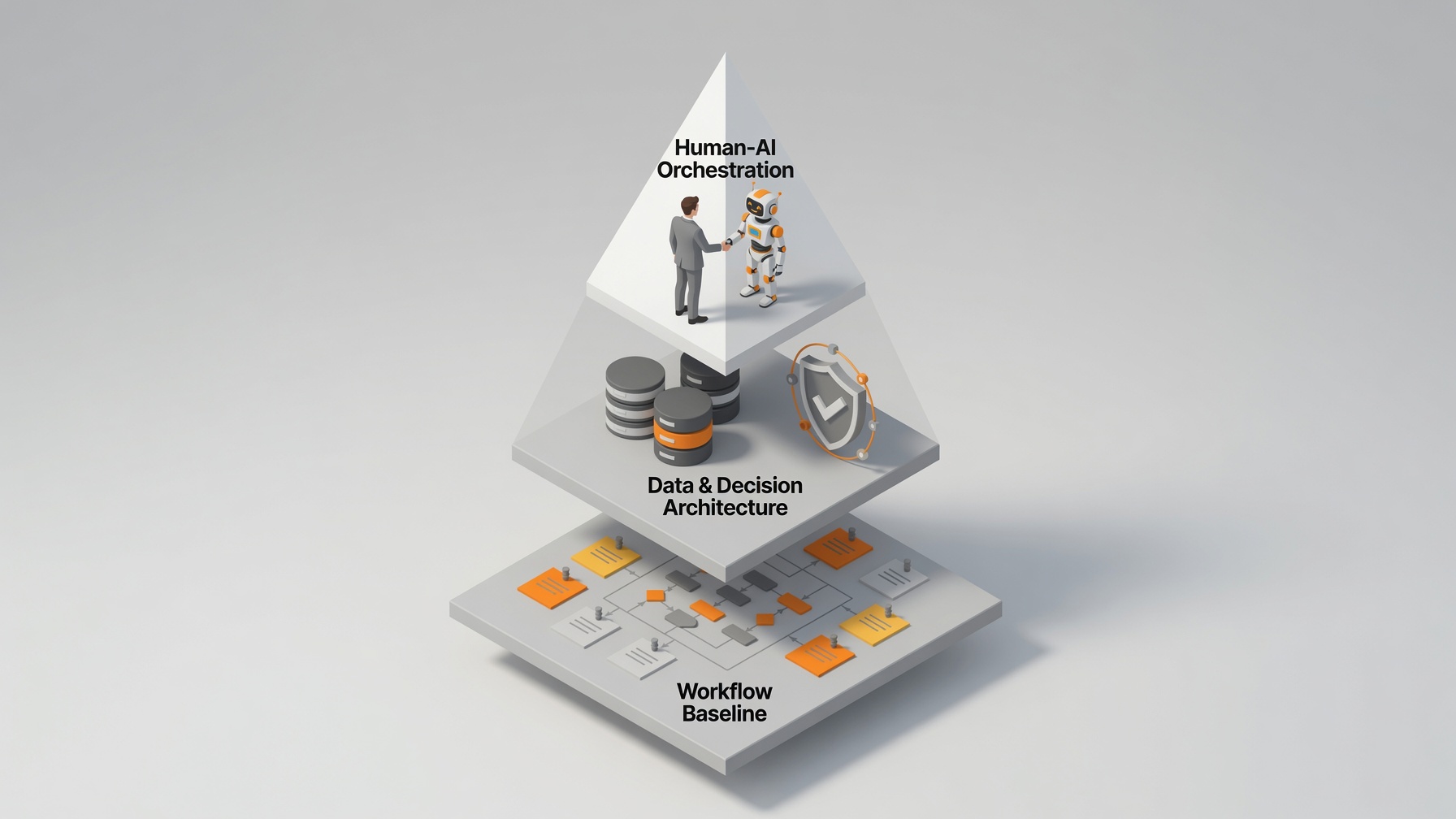
The Three Layers of AI-Ready Process Architecture
If you are an operator tasked with making AI actually pay off, here is the practical sequence:
1. Workflow Baseline (Month 1)
Before you evaluate a single vendor, map the current-state process. Not the aspirational version, the real one. Where does data actually live? Who makes the call when the model is uncertain? What are your “exception spirals”?
Question to answer: If we remove the human from this step, what breaks downstream?
2. Data & Decision Architecture (Month 2)
Clean data is table stakes. The harder work is decision architecture: defining which decisions the AI owns, which ones require human-in-the-loop, and which ones trigger escalation paths.
Question to answer: What is our confidence threshold, and who is accountable when the AI is wrong?
3. Human-AI Orchestration (Month 3+)
Design the handoff. The best implementations do not replace humans; they reseat them. The relationship manager becomes a strategic overseer. The accountant becomes a judgment validator. The logistics coordinator becomes an exception handler.
Question to answer: What is the new job description for the person this AI touches?
Where Most Teams Get Stuck (And How to Get Unstuck)
If the playbook is this clear, why do so few follow it?
Because workflow redesign is political. It touches job descriptions, power structures, incentive systems, and legacy habits. Buying software is easier than redesigning how a department works.
This is why an external, structured AI readiness assessment is often the fastest path to clarity. It forces an objective audit of your process architecture before capital gets committed to tools.
What an AI Readiness Assessment Actually Evaluates
A proper readiness assessment does not ask, “Are you excited about AI?” It asks:
Dimension | What It Uncovers |
Process Maturity | Which workflows are documented, repeatable, and measurable vs. tribal knowledge |
Data Integrity | Whether your data is connected, governed, and accessible where the work happens |
Decision Rights | Who owns the output when AI generates a recommendation |
Change Capacity | Whether your org can absorb workflow redesign without operational collapse |
ROI Pathway | The specific cost, revenue, or risk-reduction lever this AI initiative will pull |
The output is not a strategy deck. It is a go/no-go decision framework with prioritized use cases, realistic ROI timelines, and a process redesign roadmap.
Frequently Asked Questions
What Operators Ask About AI Implementation
The McKinsey AI paradox is the gap between high AI adoption and low measurable business returns. While 88% of companies now use AI, only 6% report that AI contributes more than 5% to EBIT. The paradox exists because individual productivity gains do not automatically convert to organizational ROI without workflow redesign.
According to RAND Corporation research, over 80% of AI projects fail because of organizational issues not technical ones. The top causes are misunderstood problem definitions, poor data quality, technology-first purchasing decisions, and failure to redesign workflows before deployment.
Process architecture is the deliberate design of workflows, decision rights, data flows, and human-AI handoffs before any AI tool is deployed. It ensures that AI augments operational reality rather than being layered on top of broken processes.
An AI readiness assessment evaluates five dimensions: process maturity, data integrity, decision rights, organizational change capacity, and a clear ROI pathway. It is used to determine whether a company is structurally prepared to capture value from AI before investing in tools.
The 10-20-70 rule is a resource allocation model used by successful AI adopters: 10% of budget to algorithms, 20% to technology and data infrastructure, and 70% to people, process redesign, and organizational change management.
AI ROI struggles are cross-vertical. Manufacturing faces workflow override issues; healthcare faces rigid compliance bottlenecks; financial services faces outdated governance controls; and professional services faces frozen operating models. The common denominator is always process architecture, not industry-specific technology limits.
McKinsey’s guidance suggests a 5:1 ratio: spending approximately five dollars on people, training, and workflow redesign for every one dollar spent on AI technology.
The Bottom Line for Operators
If you take one thing from this guide, let it be this:
You do not have an AI strategy problem. You have a process architecture problem that AI is exposing.
The organizations in McKinsey’s 6% where AI actually moves the P&L did not win because they bought better models. They won because they redesigned how work gets done, then used AI to accelerate the new workflow.
The rest are stuck in the paradox: more adoption, less return.
Before your next AI investment, audit your process architecture. Map the workflow. Define the decision rights. Design the human handoffs. Then and only then choose the tool.
Because in 2026, the competitive advantage is not who has the most AI. It is who has the most AI-ready operations.
Ready to stop piloting and start scaling?
If your team is preparing an AI initiative, start with an AI Readiness Assessment that evaluates your process architecture, data foundations, and organizational capacity before a single vendor call. The operators who get this right in the planning phase are the ones who end up in McKinsey’s 6%.