The Process Audit: What It Is, What We Look For, and Why It Comes Before Any Build
The Expensive Habit of Building on Quicksand
Most automation projects do not fail because the technology was bad. They fail because nobody looked at the ground beneath it.
Teams rush to automate. They buy licenses, hire developers, and scope timelines before anyone asks a simple question: What are we actually doing right now, and why?
This is where the process audit lives. It is not a formality. It is not documentation for documentation's sake. It is the single highest-leverage activity in any operational transformation because it reveals whether you are solving a workflow problem or simply accelerating a broken one.
At Agentic Agency, we do not write a line of code or configure a single agent until a process audit is complete. This article explains what that means, what we look for, and why this sequence is non-negotiable.
What Is a Process Audit?
A process audit is a structured examination of how work moves through an organization. It maps the current reality of workflows, decisions, data flows, and handoffs. It identifies friction, redundancy, ambiguity, and risk. Most importantly, it separates what people think is happening from what is actually happening.
Unlike a financial audit, which looks backward at compliance, a process audit looks forward at operational readiness. It asks:
- Where does the work start and who triggers it?
- What happens at each step, and how long does it really take?
- Where does data enter, transform, and exit?
- Who makes decisions, and what happens when they are unavailable?
- What are the exceptions, and how are they handled today?
- Which steps exist because of legacy habits, not current needs?
The output is not a list of complaints. It is a baseline. A diagnostic. A map of the territory before you redraw the borders.
What We Look For: The Agentic Agency Methodology
Our process audit methodology is cross-vertical by design. Whether we are auditing a logistics operation, a professional services firm, or a healthcare billing department, the anatomy of a broken process is remarkably consistent.
Here is what we look for across every engagement.
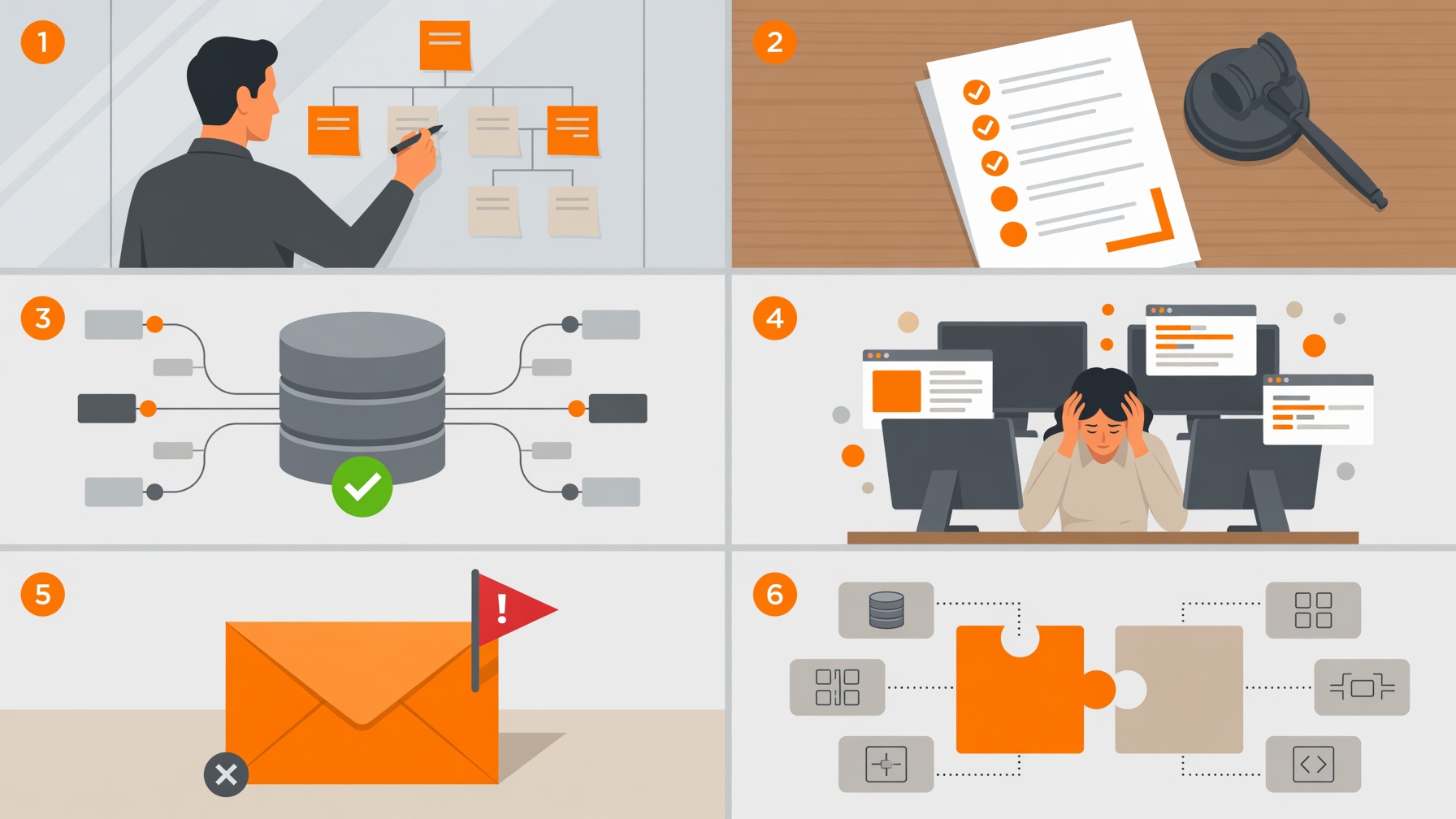
1. Workflow Fidelity
We start by mapping the current-state workflow. Not the process chart from the employee handbook. The real workflow. We use direct observation, stakeholder interviews, and system logs to reconstruct what actually happens.
We are looking for:
- Shadow steps: Tasks that exist in practice but appear in no documentation
- Workarounds: Manual fixes that compensate for system limitations
- Orphaned data: Information that gets created but never used downstream
- Circular loops: Steps that send work backward without clear criteria
If you cannot draw the current state accurately, you cannot design a future state responsibly.
2. Decision Architecture
Every workflow contains decision points. Most organizations cannot articulate who owns them, what the criteria are, or what happens when the criteria conflict.
We catalog:
- Decision rights: Who is authorized to approve, reject, or escalate?
- Decision criteria: Are they explicit, implicit, or tribal?
- Escalation paths: What happens when the primary decision maker is unavailable?
- Override patterns: How often are standard rules bypassed, and why?
This is where automation projects die quietly. If you automate a workflow with ambiguous decision rights, you automate the ambiguity.
3. Data Integrity & Accessibility
Automation is only as good as the data it touches. We audit:
- Source of truth: Is there a single source, or are there competing versions?
- Data freshness: How current is the information when a decision is made?
- Accessibility: Can the right people reach the right data at the right time?
- Quality gates: Are there any validation points, or does bad data flow freely?
We have seen companies spend six months building an AI agent only to discover that the input data was stale, duplicated, or manually corrected in spreadsheets after the fact.
4. Human Capacity & Cognitive Load
Technology changes faster than people do. We evaluate:
- Cognitive overload: Are humans acting as routers, translators, or memory banks for the system?
- Context switching: How many tools, tabs, and handoffs does a single task require?
- Skill alignment: Does the team have the capacity to operate a more complex system?
- Change fatigue: Has this team been through multiple failed initiatives already?
A process audit that ignores the human layer is just a software specification. It will fail.
5. Exception Handling
Every process has exceptions. The question is whether they are handled or ignored.
We look for:
- Exception volume: What percentage of cases fall outside standard flow?
- Exception handling: Are they routed to experts, or do they sit in queues?
- Exception documentation: Is there a pattern, or is each one treated as unique?
- Business impact: Do exceptions represent 5% of volume or 50% of revenue?
If your exception rate is high, automation without redesign will simply produce exceptions at machine speed.
6. Integration Topology
Most organizations run on a patchwork of systems that do not talk to each other. We map:
- System inventory: What tools are actually in use (not just licensed)?
- Integration health: Which connections are API-based, and which are email or CSV?
- Data latency: How long does it take for a change in System A to reflect in System B?
- Single points of failure: Which integrations, if broken, halt the operation?
Why It Comes Before Any Build
This is the part that separates operators from buyers. A process audit comes before any build for three reasons that are economic, not philosophical.
Reason 1: You Cannot Automate What You Cannot See
If you do not understand the current state, your automation project is a guess. You will build for the process you wish you had, not the one you actually have. The result is a system that sits parallel to reality, creating more work, not less.
Reason 2: Redesign Is Cheaper Before Code
Changing a workflow in a diagram takes hours. Changing it after development starts takes weeks. Changing it after deployment takes months and often requires political capital. The process audit is the cheapest phase of the entire project, and it has the highest return.
Reason 3: It Protects Against the "Automation of Broken Processes"
There is a dangerous idea in operations: that automation is always good. It is not. Automating a broken process does not save time. It scales the chaos faster. It embeds bad logic, bad data, and bad habits into a system that is now harder to change than the manual version was.
The process audit is the guardrail. It forces the question: Should we automate this, or should we fix it first?
Cross-Vertical: Where the Same Patterns Hide
We have run process audits across logistics, healthcare, financial services, legal, manufacturing, and SaaS operations. The industries change. The dysfunctions do not.
Vertical | Common Audit Finding | The Risk of Skipping It |
Logistics | Dispatch decisions made in WhatsApp groups, never logged | Automation builds on invisible data, missing 30% of edge cases |
Healthcare | Billing codes manually corrected after system submission | AI coding agents learn from dirty data, increasing denial rates |
Legal / Accounting | Partner review is the bottleneck, not document drafting | Automation speeds up associates but creates review backlogs |
Financial Services | Risk flags exist in three systems with no unified view | Compliance automation misses cross-system patterns |
SaaS / Support | Ticket routing based on keyword matching, not intent | AI routing sends complex issues to junior agents repeatedly |
The process audit is cross-vertical because operational physics are universal. Workflows break at handoffs. Decisions stall without clear ownership. Data decays at boundaries. The only variable is the industry vocabulary used to describe the same fractures.
What the Deliverable Actually Looks Like
A process audit is not a 40-page PDF that sits in a folder. At Agentic Agency, the deliverable is an operational asset. It includes:
- Current-State Process Map: A visual workflow with every step, decision, and handoff annotated
- Friction Register: A ranked list of bottlenecks with estimated time and cost impact
- Decision Matrix: Who owns what, with criteria and escalation paths defined
- Data Topology: A map of systems, integrations, and data flows with health ratings
- Readiness Scorecard: A red/yellow/green assessment across the six dimensions above
- Build Recommendations: A prioritized roadmap of what to fix, what to automate, and what to leave alone
This is the foundation upon which any automation, AI agent, or system integration should be built. Without it, you are building on assumptions. With it, you are building on evidence.
What Leaders Ask About Process Audits
Frequently Asked Questions
A process audit is a structured examination of how work flows through an organization. It maps current-state workflows, identifies bottlenecks, documents decision rights, and evaluates data integrity. The goal is to create an accurate operational baseline before any redesign or automation.
A process audit must happen before automation because you cannot fix or scale what you do not understand. Automating a broken process embeds inefficiencies into software, making them harder and more expensive to correct later. The audit reveals whether a workflow should be automated, redesigned, or eliminated.
A standard process audit checklist includes: workflow fidelity mapping, decision architecture analysis, data integrity assessment, human capacity evaluation, exception handling review, and integration topology mapping. These six dimensions cover the operational, technical, and human layers of any process.
A focused process audit for a single business function typically takes two to four weeks. Enterprise-wide audits can take six to twelve weeks depending on complexity, stakeholder availability, and system landscape. The timeline is always shorter than the rework required after a failed automation build.
A process review is usually informal and opinion-based. A process audit is structured, evidence-based, and produces a documented baseline with measurable findings. Reviews suggest improvements. Audits prove where the problems are and quantify their impact.
Yes. Process audits can be conducted remotely through a combination of video shadowing, screen sharing, system log analysis, and structured stakeholder interviews. Remote audits are often more efficient because they allow direct access to digital tools without travel overhead.
Free Process Audit
If you are preparing an automation or AI initiative, start with a process audit that maps your current reality and defines your readiness to build. The operators who audit first are the ones who scale without breaking what already works.
BOOK FREE AUDITThe Bottom Line
There is no shortage of tools promising to automate your operations. There is a shortage of operators willing to look at their operations honestly before pulling the trigger.
The process audit is not a delay. It is a discipline. It is the difference between building software that serves your business and building software that fights it.
At Agentic Agency, our methodology is simple: audit first, build second, scale third. Every time. Because the only thing more expensive than a process audit is the automation project that should have started with one.