What a Fully Instrumented RPO Operation Actually Looks Like
The Visibility Gap in Modern RPO
You have an ATS. You have a CRM. You have job boards, LinkedIn Recruiter, email sequences, and maybe a scheduling tool. On paper, your recruiting operation is digitized.
But here is the question: Can you see where every open requisition is stuck right now? Can you predict which client is about to churn before they send the complaint? Can you tell me exactly how many qualified candidates your sourcer found this week across every platform without asking them to count?
If the answer is no, you are not running a fully instrumented operation. You are running a digital version of a manual process. And the difference is not academic. It is the difference between a 15% operating margin and a 25% one. It is the difference between $2.3 million in three-year ROI and another year of hoping the numbers work out.
A fully instrumented RPO operation is not a collection of tools. It is a single system where sourcing, screening, pipeline management, client health, and financial performance are visible, connected, and actionable in real time.
Monday Morning: The Sourcing Layer
In a traditional RPO, Monday morning starts with a sourcer logging into LinkedIn, then Indeed, then a job board, then a niche platform, then a spreadsheet of past applicants. They search. They copy. They paste. They hope they are not looking at the same resume someone else already contacted last week.
By 11 AM, they have maybe 8 qualified candidates. By Friday, they are pushing to hit 30.
In a fully instrumented operation, the Multi-Source Candidate Aggregator pulls from every platform simultaneously. The system deduplicates automatically. It surfaces candidates who match the req before the sourcer finishes their coffee. The sourcer is not searching. They are reviewing, refining, and engaging.
The Resume Screening and Ranking System runs in parallel. It does not replace the recruiter's judgment. It ranks the stack so the recruiter spends time on the top 20% instead of reading 200 resumes to find 10 fits.
The result: sourcing capacity doubles from 30 to 60 qualified candidates per week. The recruiter's Monday morning is spent on outreach and relationship building, not on browser tabs and Ctrl+C.
Tuesday and Wednesday: The Pipeline Layer
In a traditional operation, the recruiting lead asks for a status update in a standup. The recruiter says the candidate is "in process." The account manager assumes that means the candidate interviewed last week. In reality, the candidate never responded to the scheduling link, and the req has been stalled for four days.
Nobody knows until the client calls asking why they have not seen any finalists.
In a fully instrumented operation, the Pipeline Velocity Dashboard is live. Every open requisition is mapped. Bottlenecks are flagged automatically. If a candidate is stuck in scheduling for 48 hours, the system alerts the recruiting lead. If a hiring manager has not reviewed a submittal in 72 hours, the account manager gets a nudge.
Issues are caught 5 days earlier than they would be in a manual tracking system. Time-to-fill drops by 15%. The recruiting lead is not chasing status updates. They are removing blockages before the client feels them.
The dashboard does not just show where things are. It shows where things are breaking, in real time, without anyone having to ask.
Thursday: The Client Layer
In a traditional RPO, client retention is reactive. The client stops returning emails. The renewal conversation gets pushed. Then the termination notice arrives. The team scrambles to save the account, but the relationship has already cooled.
In a fully instrumented operation, the Client Engagement Tracker is running continuously. It scores client health based on response times, meeting frequency, submission-to-interview ratios, and feedback sentiment. It spots the patterns that precede churn.
If a client's engagement score drops below a threshold, the relationship manager gets an early warning alert while there is still time to act. They can adjust the recruiting strategy, reset expectations, or schedule a face-to-face before the client starts shopping for another provider.
Retention improves from 70% to 85%. That is not a morale metric. It is $138,000 in recurring contract revenue protected every year.
Friday: The Operations Layer
In a traditional RPO, Friday is for reconciliation. Someone manually pulls reports from the ATS, the CRM, the accounting system, and the client scorecards. They build a deck for leadership. By the time the deck is finished, the data is already three days old.
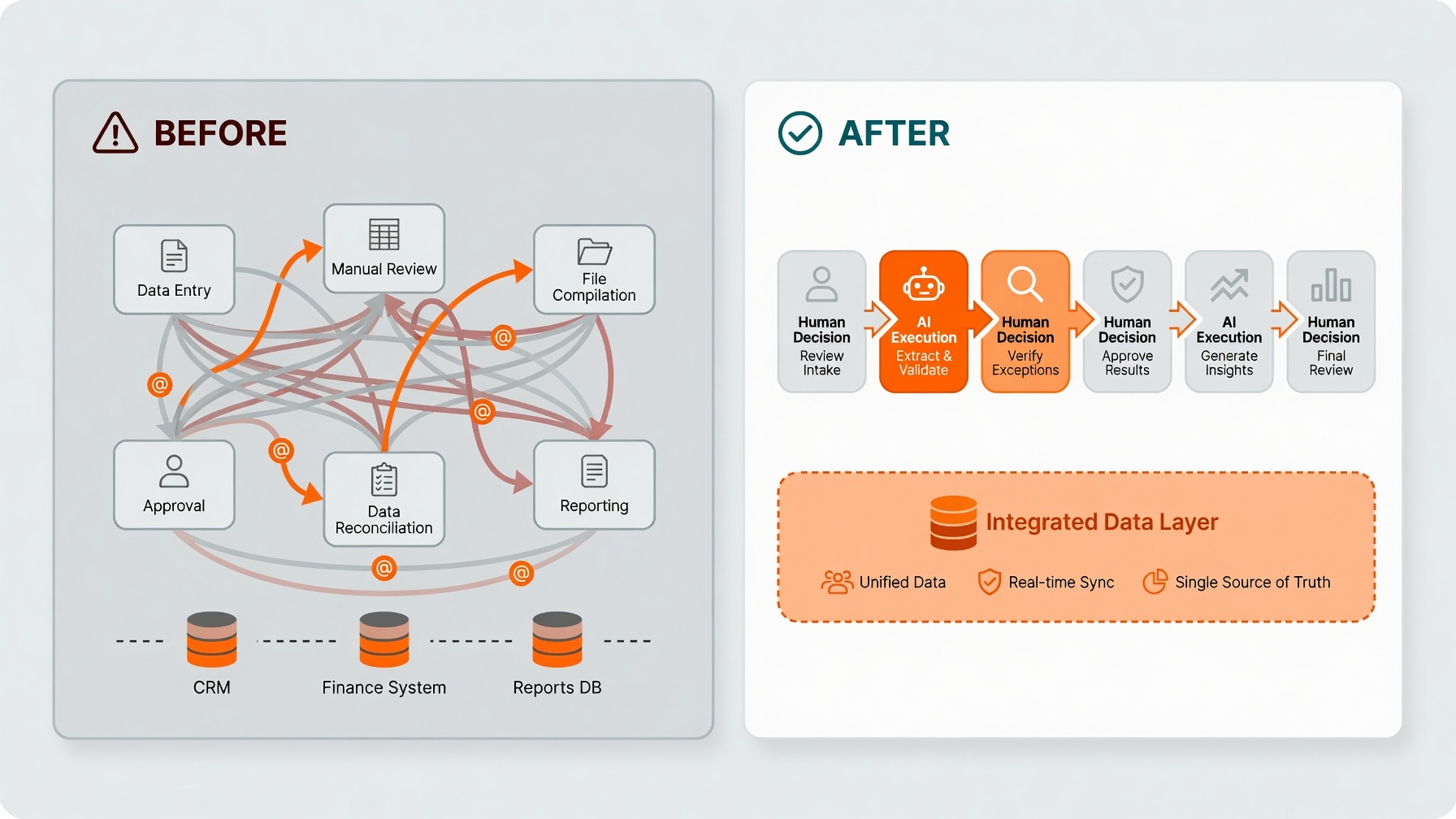
In a fully instrumented operation, the End-to-End RPO Transformation Suite connects every layer into one operating system. The sourcing data feeds the pipeline dashboard. The pipeline data feeds the client health scores. The client health scores feed the financial forecast. Leadership does not wait for Friday. They see margin, velocity, and risk in real time.
This is where the operating margin moves from 15% to 25%. Not because someone worked harder, but because the operation became visible. You can see the cost of a stalled req. You can see the revenue at risk from a cooling client. You can see which sourcer is overloaded and which account needs coverage.
The $2.3 million three-year ROI is not a projection. It is the compound effect of doubling sourcing capacity, cutting time-to-fill by 15%, protecting client revenue, and running the entire operation on a single intelligent layer instead of five disconnected tools.
The Before and After: One Recruiter's Week
Here is the simplest way to understand the difference.
Before: The recruiter spends Monday and Tuesday sourcing across platforms, manually copying data into the ATS. Wednesday is for screening 200 resumes to find 12 fits. Thursday is for chasing hiring managers for feedback that never comes. Friday is for updating a spreadsheet that nobody trusts. They placed two candidates this month. They are exhausted.
After: The recruiter starts Monday with 15 pre-ranked, pre-qualified candidates in their queue. They spend Monday and Tuesday on outreach and relationship building. Wednesday, the pipeline dashboard tells them exactly which reqs need attention. Thursday, they get an alert that a top candidate is stuck in scheduling, and they unblock it in 10 minutes. Friday, they review their metrics, celebrate three placements this month, and leave on time.
The system did not replace the recruiter. It removed the noise so the recruiter could do what they were hired to do.
What "Fully Instrumented" Actually Means
Instrumentation is not about having more software. It is about having the right connections between the right data points.
A fully instrumented RPO operation has five layers working as one system:
Table
Layer | What It Does | The Outcome |
Sourcing | Multi-Source Aggregator plus Resume Screening | Double sourcing capacity, cut screening time by 33% |
Pipeline | Velocity Dashboard with automatic bottleneck detection | Flag issues 5 days earlier, reduce time-to-fill by 15% |
Client | Engagement Tracker with health scoring | Improve retention from 70% to 85%, protect $138K annually |
Screening | Automated ranking and qualification | Cut cost-per-hire by 30%, save $122K annually |
Operations | End-to-End Transformation Suite | Unify all layers, grow margin from 15% to 25%, generate $2.3M in 3-year ROI |
These are not five separate products. They are one coherent operating model. The sourcing layer feeds the pipeline layer. The pipeline layer informs the client layer. The client layer drives the financial layer. And the operations layer makes it all visible to the people who need to see it.
The Operator's Test
If you are running an RPO and you want to know whether you are fully instrumented, ask yourself these questions:
- Can you tell me right now, without sending a Slack message, how many candidates are in first interview stage across all your open reqs?
- Can you tell me which client is most likely to churn in the next 60 days?
- Can you tell me which sourcer is producing the highest quality pipeline, not just the highest volume?
- Can you tell me your exact cost-per-hire for each client account?
- Can you tell me where your margin is leaking this month?
If you cannot answer these questions in under 60 seconds, you have tools. You do not have instrumentation.
What RPO Leaders Ask About Instrumentation
Frequently Asked Questions
A fully instrumented RPO operation is a recruitment process outsourcing firm where sourcing, screening, pipeline management, client health, and financial performance are connected into a single visible system. Data flows automatically between layers, and leaders can see bottlenecks, risks, and opportunities in real time without manual reporting.
RPO automation improves operating margin by reducing manual sourcing and screening labor, shortening time-to-fill, preventing client churn, and eliminating the administrative overhead of managing disconnected tools. Firms that implement end-to-end instrumentation typically see margins grow from 15% to 25%.
The documented three-year ROI for a fully instrumented RPO transformation suite is $2.3 million. This comes from doubling sourcing capacity, cutting time-to-fill by 15%, improving client retention from 70% to 85%, and reducing cost-per-hire by 30%.
Client churn is prevented by tracking engagement signals such as response times, submission-to-interview ratios, and feedback sentiment through a Client Engagement Tracker. Early warning alerts give relationship managers time to intervene before the client decides to leave.
An ATS tracks applicants. A fully instrumented RPO system connects sourcing, screening, pipeline velocity, client health, and financial performance into one operating layer. The ATS is one component. Instrumentation is the architecture that makes the whole operation visible and actionable.
No. Automation replaces repetitive tasks such as cross-platform searching, manual resume screening, and status chasing. Recruiters are then free to focus on candidate engagement, client relationships, and strategic hiring advice, which are the activities that actually drive placements and retention.
The Bottom Line
Most RPOs are not failing because they lack talent. They are failing because their talent is buried in manual work, their leadership is flying blind, and their clients are leaving before anyone notices.
A fully instrumented operation fixes all three problems at once. It gives sourcers their time back. It gives recruiters visibility into blockages before they become crises. It gives relationship managers early warning on client health. And it gives leadership a real-time view of margin, velocity, and risk.
The technology exists. The ROI is documented. The only question is whether you are ready to stop managing recruiting through spreadsheets and start operating it like the professional service it is.

Ready to instrument your RPO operation?
If your firm is still running on disconnected tools, manual status updates, and hope, the End-to-End RPO Transformation Suite can give you the visibility, velocity, and margin growth that fully instrumented operations already enjoy. It starts with a single audit of your current architecture.
BOOK FREE AUDIT